Carelytics
Turning caregiver reports into a clearer picture.
I built Carelytics to help make sense of caregiver reports scattered across emails and PDFs. Reading one report is straightforward. Following the story across days, shifts, and revised documents takes more work. What happened? What changed? What needs follow-up? And which source supports each observation?
The idea is to bring those pieces together: keep the source evidence, review it in context, and build a history that can be questioned and traced back to the reports. A summary is more useful when you can follow it back to the page it came from.
I use Carelytics in two ways: asking questions about the reviewed history in ChatGPT, and receiving email notifications and daily summaries through separately authorized Scheduled ChatGPT workflows. The emails help me follow what has been reported; the conversation gives me room to explore the details and their sources.
Carelytics is an evolving private prototype for an authorized family caregiver. It is also an engineering exploration: how much of this work belongs in code, where does agent judgment help, and how do we keep uncertainty visible?
How the pieces fit together
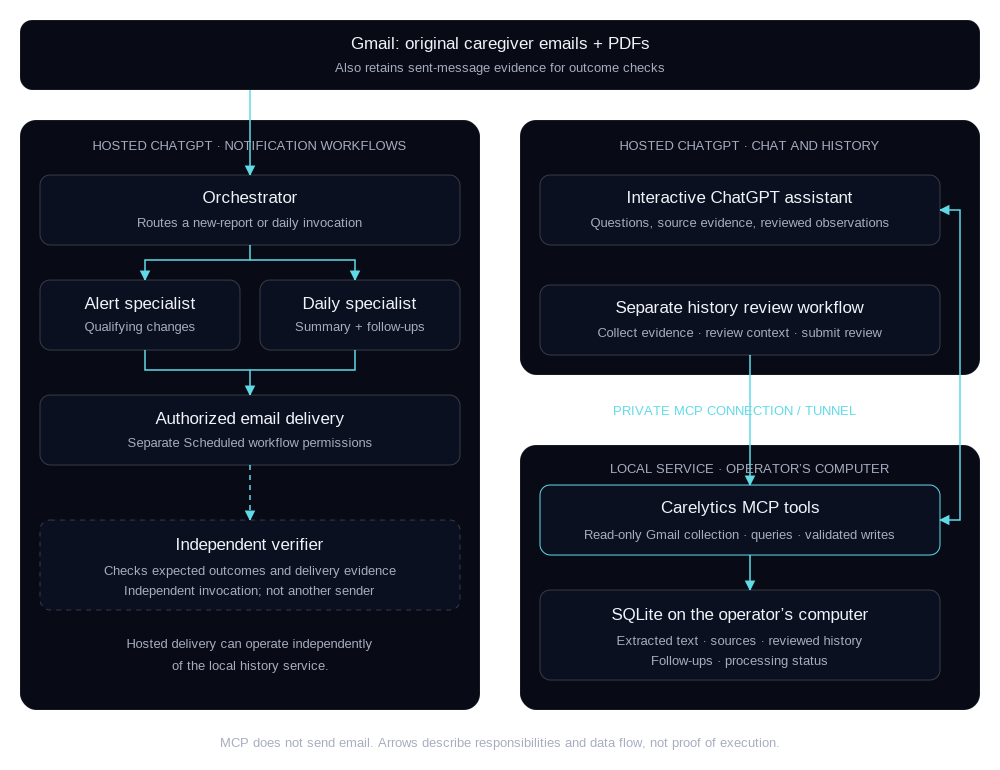
ChatGPT is the conversational assistant: the place where I ask questions about the reports and explore the reviewed history. Specialized agents review reports and prepare summaries. A private service running on my computer keeps the evidence and history, and gives the assistant focused tools to work with them.
From a question to the local tools
MCP, the Model Context Protocol, is the connection between ChatGPT and that service. Through a configured private Carelytics connection, ChatGPT reaches the service over a private tunnel and can call its tools. These tools are small software operations: retrieve a source page, check which reports have been processed, query reviewed observations, or look up follow-ups.
I use them through a ChatGPT conversation with the Carelytics connection enabled. I ask a question; the assistant calls the relevant tool, receives its results, and uses them to answer. The service and its private connection must be running for this to work. There is no public tool portal or account signup on this website.
Specialized agents, separate responsibilities
The agent roles separate review of new reports, preparation of daily summaries, and independent verification of expected outcomes. Each role has its own instructions and evidence rules. Defining a role does not by itself prove that it ran or that an outcome was verified.
A local memory of the evidence
SQLite holds extracted report text, source references, review records, and processing status. Original emails and PDFs remain in Gmail. The local service retrieves this stored evidence for the assistant rather than treating the conversation itself as the database.
Code for contracts, agents for context
Code handles storage, validation, and query contracts. Agents review document identity, dates, conflicting versions, and narrative context. These are different responsibilities: a well-formed record can still reflect a mistaken interpretation.
Observations retain source and page citations. Import validation checks structure and citation binding; it does not independently prove clinical correctness. Missing evidence and unassessed history need to stay visible.
Local core, hybrid reasoning
Keeping evidence and tools local does not mean all reasoning happens locally. Hosted ChatGPT workflows use cloud reasoning. A separate, optional review runtime supports local models and configured cloud execution, with bounded fallback for eligible failures. That experimental path is not automatically used by every workflow. Evidence returned to ChatGPT enters the hosted conversation.
Access, privacy, and prototype limits
Read-only Gmail access
With the account holder’s authorization, the local application uses read-only Gmail access to retrieve caregiver report emails and PDF attachments, inspect report history, and check prior notifications for duplicate prevention. This authorization does not allow the local service to send email.
Local storage and cloud processing
Extracted evidence, source references, reviewed observations, processing history, and Google authorization credentials are stored on the operator’s computer. When a configured cloud provider or ChatGPT workflow is used, relevant report content and instructions are processed by that provider under its applicable terms. Local storage does not mean entirely local processing.
Separate authorization for delivery
Separate user-authorized workflows can email summaries and qualifying alerts to authorized recipients. Their sending permissions are separate from the local application’s read-only Gmail access.
Human review remains essential
Carelytics is a private prototype, not a generally available healthcare product or an emergency monitoring service. History coverage can be incomplete, access can fail, and agent interpretations can be wrong. Outputs require human review and are not medical advice or a substitute for clinical care.
Built by Carlos Enrique Ortiz · HyperKode. Questions: enrique.ortiz+hk@gmail.com.